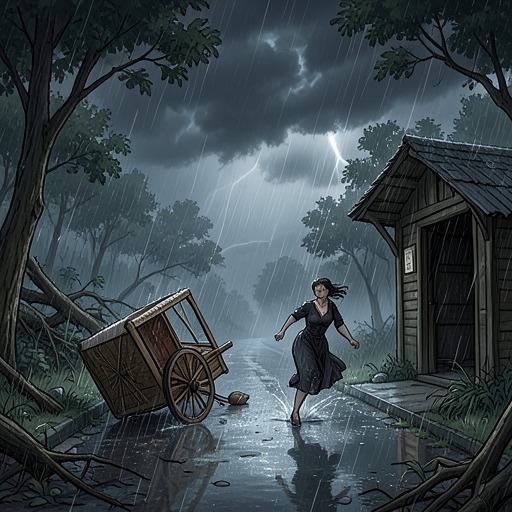
Poonguzhali and Mandakini Switch Palanquins in the Storm
Ponniyin SelvanPoonguzhali and Mandhakini Switch Palanquins in the Storm is a covert exchange made possible by a cyclone and the confusion it creates around a roadside shelter. Mandhakini leaves the palanquin in which she has been travelling; Poonguzhali takes her place, while Mandhakini is escorted away. The substitution briefly turns a journey under others’ control into a plan the two women shape themselves, but it does not secure a safe reunion: Mandhakini later vanishes in the disorder at the Thanjavur Fort entrance.
Storm and opportunity
The exchange occurs during a season already marked by uncertain weather. The monsoon has been late, the Kaveri and its tributaries have dwindled, and planted fields have begun to wilt. Then storm clouds gather rapidly, a cutting wind rises, and heavy rain follows. What had been a landscape of diminishing water becomes, within a short interval, a dangerous obstruction to travel and communication.
Poonguzhali and Sendhan Amudhan shelter in a roadside mandapam as the storm intensifies. Lightning makes brief views of the surrounding darkness possible, but the weather also disrupts movement: a banyan tree is blown down near the shelter, trapping horses and several men beneath its branches. The storm is not simply a backdrop to the exchange. It makes the stop necessary, interrupts the palanquin’s journey, and leaves the bearers and nearby travellers occupied with events they cannot easily control.
A palanquin is brought to the mandapam entrance and set down. Its screen bears the palm-tree emblem associated with the Pazhuvettarayar family. A woman inside looks toward Poonguzhali and Amudhan; the smile at her lips suggests that she recognizes them. Darkness follows the lightning flash, concealing what happens next from the sentries and, initially, from the palanquin bearers.
The substitution
Mandhakini steps out of the palanquin and approaches the pair. Poonguzhali recognizes her as her aunt. The women communicate through gestures in the dark, embracing before exchanging news. Because Mandhakini cannot speak, their understanding depends on signs and on their familiarity with one another; the scene’s essential instructions pass without a spoken conversation.
Mandhakini directs Poonguzhali to enter the palanquin and asks Amudhan to escort her to his home. Poonguzhali accepts the plan and interprets it as a ruse that may help reveal who has taken her aunt. She acknowledges the danger but trusts Mandhakini’s strategy and points to the knife at her waist as a means of defending herself if necessary. Her response is not passive substitution: she understands that taking the place of the woman expected to be inside may expose her to uncertainty, yet agrees to do it for her aunt.
After embracing Mandhakini, Poonguzhali creeps back to the palanquin, climbs in, and draws the curtains closed. The exchange is complete before the sentries notice anything. When the rain eases, the bearers lift the palanquin and continue on their way, apparently unaware that its occupant has changed. The concealed transfer divides the women’s routes: Poonguzhali travels in the palanquin, while Mandhakini leaves with Amudhan.
Reconstruction and immediate aftermath
The substitution is later reconstructed by Aniruddha Brahmaraayar from the circumstances and confirmed by Azhwarkkadiyaan, who had watched from the shelter. Aniruddha reasons that the bearers had set the palanquin down during the gale, that Poonguzhali had helped her aunt out and taken her place, and that the falling tree had left Amudhan unconscious and unable to notice the change. Azhwarkkadiyaan confirms that he saw Poonguzhali enter after Mandhakini had come out; the bearers, he says, noticed nothing before carrying the palanquin onward.
Poonguzhali herself tells Aniruddha that the palanquin had been empty when she approached the Thanjavur Fort and that she entered it voluntarily to escape the downpour. Her account and the eyewitness reconstruction establish that the ride was not forced upon her: she chose the substitution after meeting Mandhakini at the shelter. The episode thus carries two versions of apparent captivity at once—the outward appearance of a woman being transported in the palanquin, and the concealed fact that its passenger has deliberately taken another’s place.
The exchange does not end with an uncomplicated escape. Mandhakini reaches Sendhan Amudhan’s home, where Poonguzhali and Azhwarkkadiyaan later find her. They persuade her to accompany them to the fort, explaining that the ailing Sundara Chozhar wishes to see her. At the entrance, Mandhakini joins the crowd rather than following the proposed secret route. Some onlookers remark that she resembles the Pazhuvoor Ilaiya Rani; soldiers intervene, and the resulting street clash separates her from Poonguzhali and Azhwarkkadiyaan. When the disturbance subsides, she is missing.
Significance
The switch depends on a small interval in which usual safeguards fail: storm, darkness, a halted palanquin, distracted bearers, and private communication through gestures. Each condition contributes to the deception, while the brief lightning flashes offer glimpses rather than continuous knowledge. The reader and the characters must piece together what happened from partial sight and later testimony.
The palanquin’s closed curtains make identity seem to travel with the vehicle, but the women expose that appearance as unreliable. A change of passenger alters who is being conveyed and who is free to move, without the people responsible for carrying the palanquin realizing it. Yet the exchange only redirects danger; it does not remove it. Poonguzhali’s chosen risk and Mandhakini’s temporary escape lead into the larger uncertainty of the fort crowd, where recognition, political suspicion, and public disorder again overwhelm the women’s carefully made arrangements.